
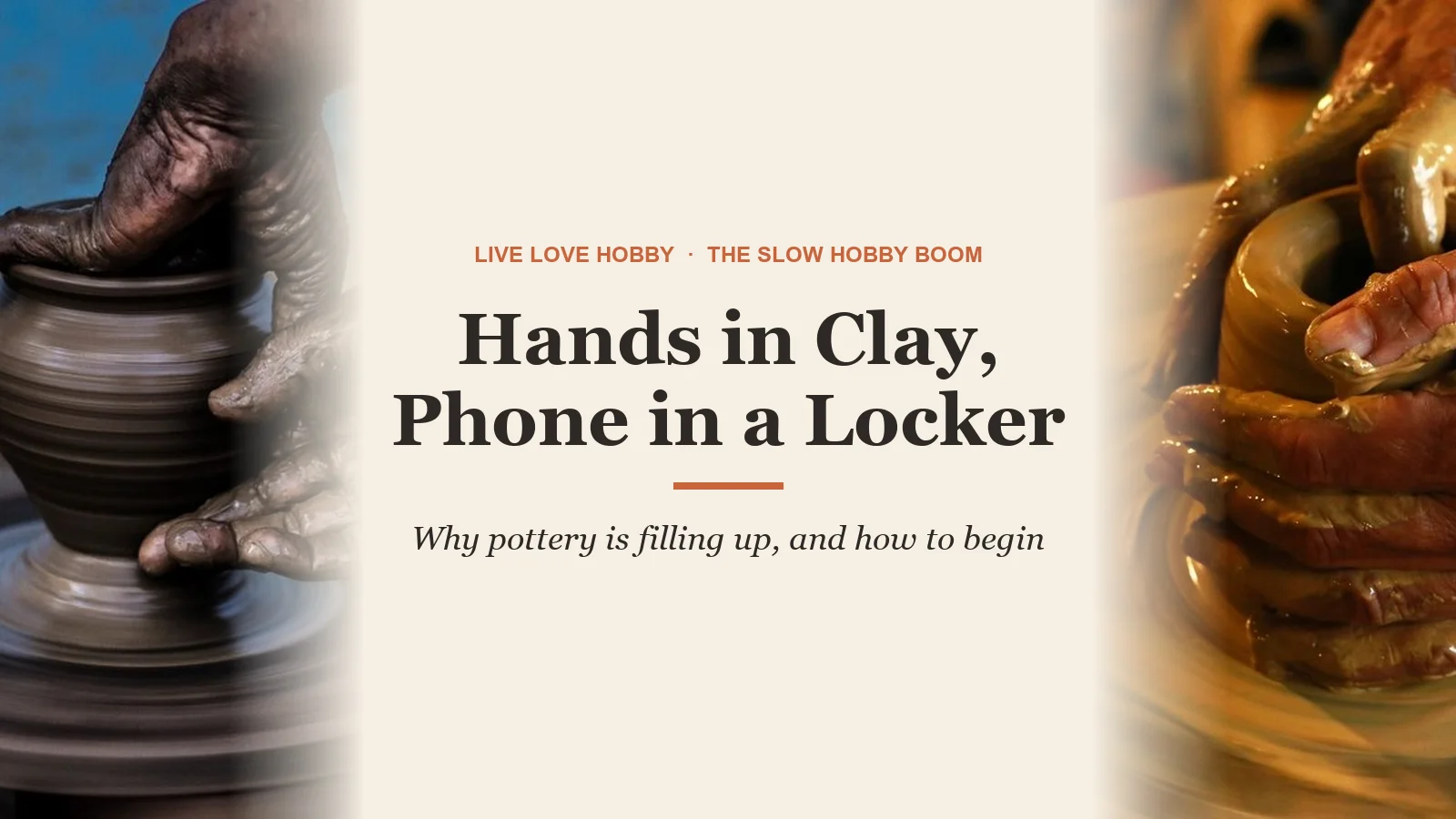
Picture someone who spends all day on screens walking into a ceramics studio at 7 p.m. on a Tuesday. The phone goes into a cubby. The apron goes on. Ten minutes later, a lump of wet clay wobbles on the wheel and collapses for the third time.
Nobody in the room is in a hurry. The teacher says, “Again.” And for the first time all day, the only thing on this person’s mind is the clay.
Quick answer
To start pottery, try a one-night taster or air-dry clay at home first, then sign up for a multiweek beginner wheel class that includes clay, kiln firings and open studio time. Beginner courses commonly run six to seven weeks, and some popular sessions sell out, so register early.
Key takeaways
- Pottery is a slow hobby: clay must dry and be fired, so it rewards patience over speed.
- Studios are multiplying in some cities, and some beginner sessions sell out ahead of time.
- Research links making crafts to higher life satisfaction, though it is not a substitute for care.
- Check whether a class includes clay, kiln firings and open studio time before comparing prices.
- Air-dry clay is a low-commitment test, but it is not waterproof or food safe.
What is a slow hobby, and why is pottery the classic example?
A slow hobby is one you can’t rush. The process sets the pace, not you. Bread has to rise. A garden has to grow. Clay has to dry before it can be trimmed, dry again before it can be fired, and go back into the kiln after it’s glazed.
Pottery makes that slowness visible. A mug you throw on the wheel this week may not be finished for weeks, depending on your studio’s firing schedule. You can’t speed that up with a better phone or a faster internet connection, and that is a big part of the appeal.
It is also stubbornly physical. You have to center the clay with your hands, feel when the walls are too thin, and accept that some pieces will slump, crack or warp. The clay tells you, right away, when your attention has drifted.
For a lot of people, that is the point. A slow hobby gives you an evening where the only notification is wet clay sliding off center.

Is pottery really booming?
There is no single national count of pottery students, so we looked at what studios and local reporting show. The signals point the same way.
In San Francisco, ABC7 reported in March 2026 that neighborhood ceramics studios are spreading across the city. Steve Allen, owner of SMAart Gallery & Studio, told the station that in 2012 the city had only a handful of pottery studios. He now estimates there are around 26.
The same report noted that many people came back to creative hobbies during the pandemic, while others are now looking for a break from constant screen time. That second group is the one studios keep describing: people who want an activity where the phone has to stay out of reach because their hands are covered in clay.
Demand shows up in class listings, too. At the Nassau County Museum of Art on Long Island, the Introduction to Wheel Throwing page marks its first fall session as sold out on all three class days, Tuesdays, Wednesdays and Saturdays. The second fall session was still open when we checked.
None of that adds up to a precise national number. But if you have tried to book a beginner wheel class in a busy area lately, you may already have noticed the waitlists.
Why do people find working with clay so calming?
Ask potters and you hear about touch. “I do like the touch of clay, the way the clay responds to every touch,” Allen told ABC7. Katie Petro, co-owner of KnK Contemporary, who has taught at one of Allen’s studios, said many of her students work in tech or finance and feel disconnected. She described clay as “very grounding.”
Research on crafts more broadly backs up some of that feeling. A study led by Dr. Helen Keyes at Anglia Ruskin University, published in August 2024 in Frontiers in Public Health, analyzed data from 7,182 people in England’s Taking Part survey. People who did arts and crafts reported higher happiness and life satisfaction, and a stronger sense that life is worthwhile, even after accounting for age, health, employment and deprivation.
“Indeed, the impact of crafting was bigger than the impact of being in employment.” Dr. Helen Keyes, Anglia Ruskin University
The study also found that 37.4% of respondents had taken part in at least one craft activity in the previous twelve months. That is a lot of people already making things with their hands.
Two honest caveats. The research is a survey analysis, so it shows a link, not proof that crafting causes better wellbeing. And a pottery class is a hobby, not treatment. If you are struggling with stress, anxiety or low mood, talk to a licensed professional, and treat the studio as one helpful part of your week.
If you have been feeling worn down by your usual creative outlets, our guide on how to recover from creative burnout pairs well with trying a brand-new medium like clay.
Try this weekend: an air-dry clay pinch pot
- Roll a piece of air-dry clay about the size of a tangerine into a smooth ball.
- Press your thumb into the center, stopping before you break through the bottom.
- Pinch and turn, working from the bottom up, until the walls are an even thickness.
- Smooth any cracks with a damp fingertip, then let it dry fully before painting or sealing.
Time: about 30 minutes of making, plus drying time. Cost: a small package of air-dry clay. Keep it decorative, since air-dry clay isn’t waterproof.
More project ideas
How do you start pottery as a complete beginner?
You do not need to buy a wheel or a kiln. Most beginners move through four steps, and you can stop at any one of them.
1. Test your interest with air-dry clay
Air-dry clay lets you try pinch pots and small sculptures at the kitchen table. Know its limits before you start. Crayola, for example, says its air-dry clay can be sealed with an acrylic varnish once a piece is completely dry after 72 hours, but sealing does not make it waterproof, and pieces are best displayed indoors. Use it for decorative pieces, not for mugs or bowls that will hold food or drink.
2. Book a one-night taster
Many studios run single-evening wheel or hand-building sessions. They are a low-stakes way to find out whether you enjoy the mess, the noise of the wheel, and the patience it takes to center clay.
3. Take a multiweek beginner course
This is where real progress happens. A series of weekly classes gives you time to learn centering, pulling walls, trimming and glazing, with a teacher correcting your hands along the way.
4. Join a studio as a member
Once you can center and throw a basic cylinder, a membership typically gives you shelf space and open studio hours to practice on your own. Ask what firing fees and clay purchases cost on top of the monthly rate.
For a closer look at what happens on the wheel, our beginner’s guide to pottery wheel basics walks through centering and throwing step by step.
Wheel or hand-building first?
The wheel gets the attention, but it is not the only door in. Hand-building uses pinching, coils and flat slabs, and it needs nothing more than a table, a few simple tools and access to a kiln. It is quieter, slower and often easier on beginners who find the spinning wheel intimidating.
The wheel, on the other hand, teaches centering and symmetry and is hard to beat for mugs and bowls. If a studio offers both, many beginners enjoy starting with a hand-building session, then moving to the wheel once they understand how clay dries and cracks. Neither path is wrong. Pick the one that makes you want to come back next week.

How much does a beginner pottery class cost?
Prices vary widely by region and by what is included, so compare the whole package rather than the headline number. Two real fall 2026 examples show the range:
| Studio | Course | Price | What’s included |
|---|---|---|---|
| Adrian Center for the Arts (Michigan) | Beginner Wheel Throwing, six Monday evenings, 3 hours each | $300 | 25 lbs of clay and open studio time |
| Nassau County Museum of Art (New York) | Introduction to Wheel Throwing, 6 weeks | $427.50 members, $450 non-members | A 12 lb bag of clay, kiln firings, shelf space, one optional weekly open studio session |
The Adrian course listing also notes that extra clay is available for purchase. Nassau’s page lists a seven-week option at $498.75 for members and $525 for non-members.
Before you register anywhere, ask these questions:
- Is clay included, and how much? A bag or two is typical for a beginner course.
- Are firings included? Some studios charge separately for bisque and glaze firings.
- Is there open studio time? Practice between classes is where centering finally clicks.
- How long until pieces are ready? Firing schedules mean your last pieces may come home after the course ends.
- What should I wear? Clay splatters. Our post on choosing an outfit for pottery class covers the basics.
What should you expect in your first six weeks?
Expect the first week or two to feel humbling. Centering is the skill that stops most beginners, and it often takes several sessions before the clay stops wobbling under your hands.
By the middle of a course, many students can pull a short cylinder. It may lean. The walls may be thick. That is normal, and it is still a real pot.
Toward the end, you’ll trim pieces once they’ve firmed up and choose glazes. The studio fires them, and you get to open the kiln shelf and see what the heat did. Glazes often look nothing like they did going in, which is either the best or most surprising moment of the course.
Keep your expectations about output low and your expectations about attention high. Most beginners bring home only a few keepers from a first course. What they keep, more often, is the habit of a weekly evening where nothing moves faster than the clay.
Is a slow hobby worth the time when life is already busy?
It can feel backwards to add a weekly class to a crowded calendar. But that fixed evening is the structure that makes a slow hobby work. You show up, the phone goes in the cubby, and the next two or three hours belong to one thing.
If a full course feels like too much, start with air-dry clay this weekend and a taster class next month. The clay will still be there.
Back in that Tuesday-night studio, the fourth lump of clay finally holds. It is a lopsided little cylinder, and it will take weeks of drying and firing before it becomes a cup. That wait is not a flaw in the hobby. It is the hobby.
Share your project
Did you finally center your first lump of clay, or make a pinch pot at the kitchen table? Send us a photo of your first piece, wobbles and all. We’d love to hear how your first class went.
Frequently asked questions
Is pottery hard to learn?
The basics are learnable, but centering clay on the wheel takes most beginners several sessions to feel comfortable. Hand-building methods like pinch pots and coil pots are easier to start with and still teach how clay behaves.
Do I need my own pottery wheel to start?
No. Most beginners learn in a class or community studio that supplies wheels, tools and kiln access. It makes sense to wait on buying equipment until you know you will keep at it.
Can I make mugs and bowls with air-dry clay?
Air-dry clay is best for decorative pieces. Crayola notes that sealing its air-dry clay does not make it waterproof. For anything that holds food or drink, use kiln-fired clay and food-safe glazes through a studio.
How long does it take for pottery to be finished?
It depends on drying time and your studio's firing schedule. Pieces need to dry, go through a first firing, be glazed and then fired again, which can take several weeks from wheel to finished piece.
What should I bring to my first pottery class?
Wear clothes you don't mind getting clay on, trim long nails if you can, and tie back long hair. Ask the studio whether tools and an apron are provided or whether you should bring a towel and a basic tool kit.
Sources
- ABC7 San Francisco: Bay Area neighborhood ceramics studios grow in popularity
- Nassau County Museum of Art: Introduction to Wheel Throwing
- Anglia Ruskin University: Arts and crafts boost mental wellbeing, new study
- Crayola: Can Air-Dry Clay pieces be sealed?
- Adrian Center for the Arts: Beginner Wheel Throwing (6 weeks)
Read us often? Make Live Love Hobby a preferred source in Google Search and see our reporting more often in Top Stories.